Cancer remains one of the country's leading causes of death, with lung cancer recording the highest number of cancer-related deaths. But beyond the statistics lies a bigger question: Are Filipinos getting the early detection and treatment they need, or is the cost of survival putting lives at risk?
Cancer does not always announce its presence. In many cases, it develops without obvious warning signs, leaving patients unaware of the disease until it has progressed. By the time symptoms become noticeable, treatment may already be more complicated, expensive, and difficult.
In the Philippines, cancer continues to pose a significant public health challenge, affecting not only patients but also families who must navigate medical expenses, hospital procedures, and prolonged treatment.
The latest available government statistics underscore the scale of the problem. According to the Philippine Statistics Authority (PSA), neoplasms, which include cancers, ranked as the country's second-leading cause of death in the first four months of 2026, following ischemic heart disease.
But while the numbers reveal the country's growing health concerns, they also raise a more pressing question: How accessible is cancer care for ordinary Filipinos?
The Numbers Behind the Cancer Burden
The PSA's provisional report, released on October 28, 2026, recorded 19,304 deaths attributed to neoplasms from January to April 2026, accounting for 10.6% of all registered deaths during the period.
Ischemic heart diseases remained the leading cause of death, while cerebrovascular diseases ranked third.
The country's three leading causes of death during the reporting period were:
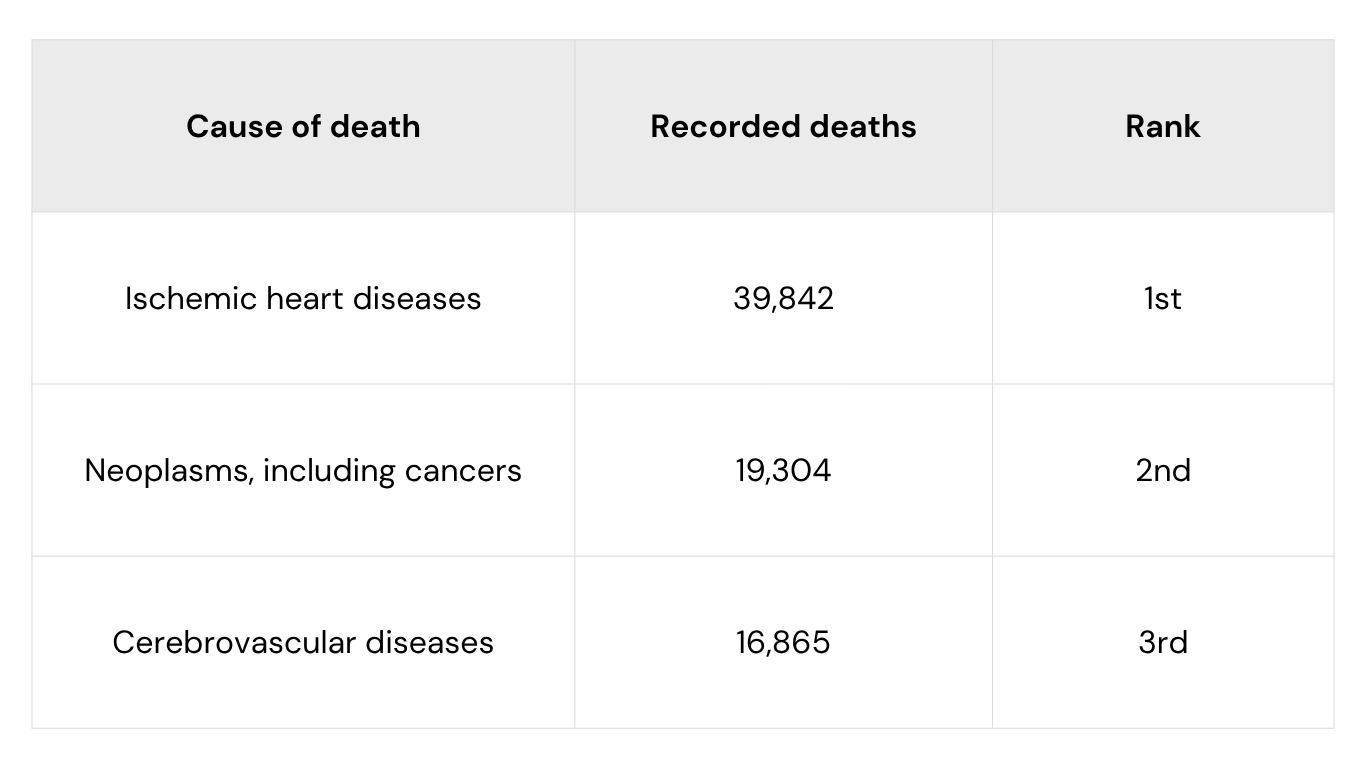
These figures cover January to April 2026 and remain provisional. They should not be interpreted as full-year statistics.
Although cancer is not the country's leading cause of death overall, its position among the top causes highlights the importance of prevention, early diagnosis, and accessible treatment.
Which Cancer Claims the Most Lives?
While breast cancer is the most frequently diagnosed cancer in the Philippines, lung cancer ranks first in cancer-related deaths when men and women are considered together.
According to the World Health Organization's International Agency for Research on Cancer (IARC), through its GLOBOCAN 2022 estimates, the Philippines recorded approximately 113,369 cancer deaths across all cancer types.
Lung cancer accounted for the largest share, with an estimated 20,953 deaths, representing 18.5% of the total.
The leading cancer types by estimated deaths were:
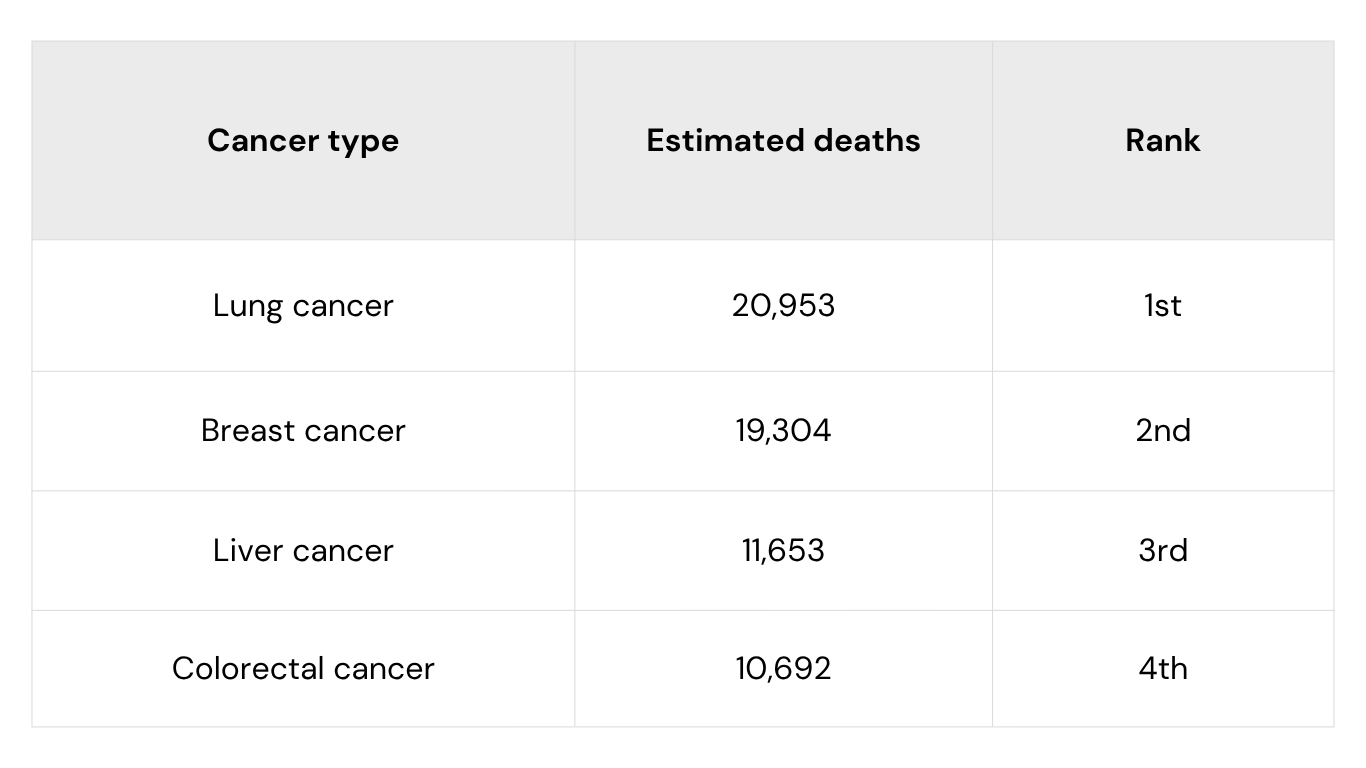
Source: IARC GLOBOCAN 2022. These are internationally comparable estimates, not actual 2026 cancer death counts.
The distinction between cancer incidence and mortality is important. Breast cancer leads in the number of newly diagnosed cases, while lung cancer accounts for the highest number of cancer deaths.
This difference highlights why awareness should go beyond identifying the most common cancer. Understanding which cancers cause the most deaths, recognizing risk factors, and improving access to appropriate screening and diagnosis are equally important.
The Danger of Late Detection
One of the biggest challenges in cancer care is discovering the disease before it reaches an advanced stage.
Some cancers may develop with few or no noticeable symptoms during their early stages. Others produce warning signs that can easily be mistaken for less serious health problems.
However, the absence of symptoms does not necessarily mean a person has cancer, and not every cancer requires the same screening approach.
The World Health Organization (WHO) distinguishes between early diagnosis and screening. Early diagnosis involves identifying possible cancer symptoms and ensuring that patients receive timely medical evaluation. Screening, meanwhile, aims to identify certain cancers or precancerous changes before symptoms appear.
Both approaches are important, but they depend on accessible healthcare facilities, trained medical professionals, appropriate diagnostic equipment, and timely referrals.
The challenge is whether these services are equally accessible to Filipinos across different income groups and geographical locations.
For families outside major urban centers, accessing specialized medical services may involve traveling to larger cities, additional transportation expenses, and time away from work.
When diagnostic procedures and specialist consultations are difficult to access, delays can become another obstacle in an already challenging healthcare journey.
The Cost of Staying Alive
For many Filipino families, a cancer diagnosis brings more than emotional distress. It can also trigger a prolonged financial struggle.
Depending on the type and stage of cancer, treatment may involve surgery, chemotherapy, radiation therapy, targeted medicines, diagnostic procedures, hospitalization, and regular follow-up consultations.
These expenses can accumulate over months or even years.
Even when patients qualify for government assistance or health insurance benefits, families may still need to shoulder transportation, accommodation, medicines, additional tests, and other expenses associated with treatment.
The government has established financial assistance mechanisms to help address these challenges.
Under Republic Act No. 11215, or the National Integrated Cancer Control Act, the Cancer Assistance Fund (CAF) was established to support cancer medicines, treatment, diagnostics, and other care-related services for priority cancer types.
PhilHealth also provides selected cancer treatment packages through its Z Benefits program. Its current benefits include coverage for breast cancer, cervical cancer, prostate cancer, colorectal cancer, and certain childhood cancers, subject to eligibility requirements and contracted healthcare facilities.
For example, PhilHealth's enhanced breast cancer package provides up to ₱1.4 million in benefits for eligible patients from clinical stages 0 to IV.
These programs represent important steps toward reducing the financial burden of cancer. However, the existence of assistance programs must also translate into actual access.
Patients and families need clear information about eligibility, application procedures, participating hospitals, available medicines, and the extent of financial coverage.
The question is not simply whether assistance exists, but whether those who need it most can access it when they need it.
Prevention Begins Before a Diagnosis
While not all cancers can be prevented, several established risk factors can be addressed through public health initiatives and individual health decisions.
According to the WHO, approximately 38% of cancer cases worldwide could be prevented through reducing exposure to known risk factors and implementing existing prevention strategies.
These include:
Tobacco use: Avoiding cigarettes and other tobacco products can reduce the risk of several cancers, particularly lung cancer.
Alcohol consumption: Limiting or avoiding alcohol can help reduce the risk of alcohol-related cancers.
Healthy eating and physical activity: Maintaining a healthy weight, eating a balanced diet, and staying physically active can help lower the risk of certain cancers.
Vaccination: HPV vaccination helps prevent several HPV-related cancers, particularly cervical cancer, while hepatitis B vaccination helps reduce the risk of liver cancer.
Regular medical consultations: Seeking medical advice about unusual or persistent symptoms and following age- and risk-appropriate screening recommendations can support early detection.
Prevention, however, should not be treated as a guarantee against cancer. Genetics, age, environmental exposure, and other factors can also contribute to the disease.
This is why public education must go hand in hand with accessible screening, diagnosis, and treatment services.
Is the Healthcare System Reaching Those Who Need It?
The Philippines has already taken legislative steps to strengthen cancer prevention and treatment.
The National Integrated Cancer Control Act established a framework for cancer prevention, early detection, diagnosis, treatment, rehabilitation, survivorship, and palliative care.
The Department of Health's Philippine Cancer Control Program also identifies community-based screening, HPV vaccination, cancer awareness, and improved access to treatment as important components of national cancer control efforts.
However, the effectiveness of these programs must be measured beyond policies and announcements.
Are government hospitals adequately equipped to provide cancer diagnostics and treatment? Are patients in provincial communities receiving the same opportunities for early detection as those in major cities? Are financial assistance programs reaching low-income families without unnecessary delays?
These are questions that deserve clear answers from government agencies and healthcare institutions.
The private sector also has a role to play. Hospitals, pharmaceutical companies, foundations, corporations, and medical organizations can contribute through patient assistance programs, affordable diagnostic services, treatment partnerships, research, and public education.
Cancer care requires more than medical innovation. It requires a healthcare system that allows patients to benefit from those advancements regardless of their financial circumstances.
Beyond the Statistics: Cancer Should Not Be a Financial Death Sentence
The latest figures offer a sobering reminder of the country's cancer burden. But behind every recorded death is a person, a family, and a community affected by the disease.
For some, the battle begins with an unexpected diagnosis. For others, it becomes a difficult decision between continuing treatment and managing the household's daily expenses.
Medical science continues to advance, offering improved methods of detection, treatment, and patient care. Yet these developments mean little to families who cannot afford diagnostic procedures, access specialized hospitals, or complete prescribed treatment.
This is where the national conversation must move beyond mortality figures.
Cancer should not become a death sentence simply because a patient cannot afford early detection, proper diagnosis, or treatment.
The challenge for the Philippines is not only to reduce the number of cancer cases and deaths, but also to ensure that healthcare assistance reaches the people who need it most.
As the country continues to strengthen its cancer-control programs, government agencies, medical institutions, and private organizations must be held accountable for turning healthcare commitments into accessible services.
Because the fight against cancer should be about giving people a better chance to live, not forcing families to fight another battle just to afford that chance.
Sources and references
The article's central statistics and policy references are supported by the following:
PSA, 2026 Underlying Causes of Death in the Philippines, October 28, 2026.
Philippine Statistics Authority+1
WHO International Agency for Research on Cancer, GLOBOCAN 2022 – Philippines Fact Sheet.
WHO, Cancer Fact Sheet, July 3, 2026.
World Health Organization
Department of Health, Philippine Cancer Control Program.
Department of Health
Republic Act No. 11215, National Integrated Cancer Control Act.
Issuances Library+1
PhilHealth, Z Benefits and Cancer Treatment Packages.